Northern elephant seal
Differences between northern and southern elephant seals
The genus Mirounga comprises two species, the southern elephant seal
(M. leonina) and the northern (M. angustirostris). Northern
elephant seals breed in California and Baja California, mostly on offshore
islands but also on the mainland (in particular , in the Ano Nuevo Reserve
near Santa Cruz). Distribution of feeding grounds at sea is much wider,
with some individuals reaching the Gulf of Alaska. Northern elephant seals
were hunted almost to extinction during the 19th century, but after the
introduction of protection laws in the United States and Mexico the species
recovered at fast rate, and expanded outside its previous breeding range.
For many aspects, the two species of the genus Mirounga are very similar: external appearance, behaviour at sea, movement on land, gross traits of mating system and reproductive behaviour. The first difference is size, with the southern species much larger. In northern elephant seals maximum weight is about 2300 kg for males versus 3700 kg for southern, while females are more similar. On the contrary, secondary sexual traits are more developed in the northern species: the trunk is longer, and the nack and chest shield is more developed.
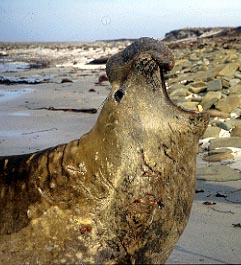
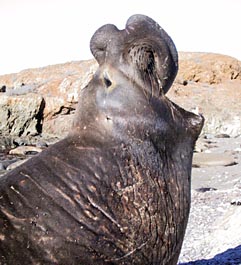
Elephant seal trunks, southern on the left and northern on the right
The two species have similar breeding cycle, but they breed at diffent
time of the year (January-February in the northern species, September-November
in the southern), and present differences in breeding strategies: in particular,
length of lactation is longer in northern elephant seals (24-28 days)
than in southern (22-23), and also post-weaning fast is longer (56-74
days versus 37).